









Neodymium-Iron-Boron (NdFeB) is the most powerful commercially available permanent magnet material. The material is based on an alloy of neodymium, iron and boron and, due to its content of the rare-earth element neodymium, belongs to the group of rare-earth magnets. NdFeB is therefore one of the critical raw materials for numerous high-tech sectors.
Due to its high energy density, NdFeB is indispensable for a wide range of applications, including electric motors, consumer electronics, medical devices, and industrial drive systems. Emerging industries such as electric vehicles (EVs), wind power, and humanoid robots have driven a recent spike in demand for high-performance NdFeB magnets.
The magnetic properties of NdFeB magnets are influenced not only by chemical composition but also by the physical or microstructural characteristics of the powder used. Particle size after milling plays a critical role in determining key magnet properties as maximum energy product ((BH)max), intrinsic coercivity (HcJ) and magnet remanence (Br).
Production of NdFeB magnets and quality control of milling
The industrial production of sintered NdFeB magnets involves several process steps. After alloying, the material is mechanically broken down and finely milled. The resulting microcrystalline powder is then aligned in a magnetic field, pressed, and sintered.
Precise milling ensures the particle size matches the target specification, which is essential for the density and magnetic anisotropy of the finished magnet. Even small deviations in particle size or distribution can lead to significant variations in magnetic properties and overall performance.
If the powder contains too many coarse particles, the maximum energy product ((BH)max) decreases due to poor packing density and reduced orientation efficiency, while intrinsic coercivity (HcJ) drops as a result of weakened magnetocrystalline anisotropy from larger grain sizes. Too many fine particles increase the risk of oxidation and burning due to their large specific surface area; during sintering, they tend to form larger crystallites and can cause uneven densification, both compromising (BH)max and HcJ. A narrow particle size distribution and appropriately small mean particle size are therefore essential to ensure the desired magnetic performance.
The optimal particle size of NdFeB powder is typically around 2.5 µm to 2.6 µm. In production, a control range of 3 µm to 5 µm is often applied. Crucially, it is not only the mean particle size that matters but the entire particle size distribution.
Challenges in measuring NdFeB powders
Due to their high magnetic and cohesive properties, NdFeB powders present significant analytical challenges. The material is very fine, and highly cohesive. Strong magnetic adhesion forces between particles lead to the formation of stable agglomerates that are difficult to disperse reliably, which severely interferes with particle size determination.
Due to its many advantages, laser diffraction technology has been widely adopted for characterising NdFeB powders. It can provide comprehensive information on particle size distribution, including critical parameters such as mean particle size, x10, x50 and x90, which directly correlate with the final magnet’s performance. However, the effective dispersion of magnetic agglomerates remains a key technical bottleneck for accurate and reliable particle size characterisation of this highly magnetic material.
Traditional wet dispersion is ineffective for NdFeB magnetic agglomerates. Even the use of ultrasound results in measured particle sizes that are around five times larger than the actual value. In contrast, dry dispersion using the powerful RODOS compressed air injector ensures effective particle separation, providing reliable and reproducible results that guide industrial production.
Comparison between wet and dry measurement

Comparison of particle size distributions of NdFeB powder measured dry and wet, proving the unrivalled capabilities of the RODOS dry disperser.
Laser diffraction for the analysis of magnetic powders
Laser diffraction has established itself as a powerful method for analysing the particle size of fine and cohesive powders and is also widely used for magnetic materials such as NdFeB. It allows the full particle size distribution to be determined across a broad measurement range and delivers reproducible, comparable results.
For NdFeB powders, dry measurement is particularly advantageous, as the material is generally handled dry and wet chemical influences can be avoided. Effective dispersion is essential, particularly for magnetic powders, in order to break up agglomerates and achieve reliable measurement results.
Laser diffraction analysis with HELOS & RODOS
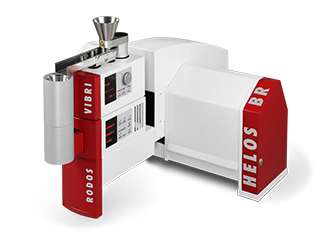
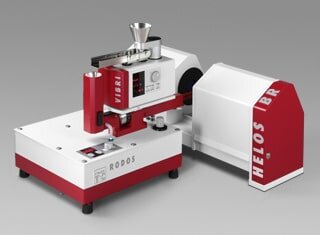
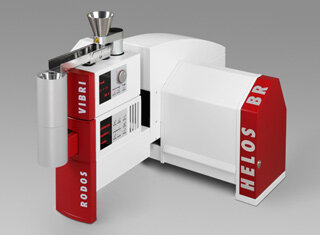
The combination of the HELOS laser diffraction sensor with the RODOS dry disperser is designed for demanding powder applications. Coupled with inert compressed gas and a flame-proof vacuum cleaner, RODOS provides high dispersing energy, allowing even strongly magnetic and cohesive NdFeB powders to be reliably deagglomerated.
With HELOS & RODOS, NdFeB powder is measured directly without sample preparation. The system delivers high-resolution particle size distributions with excellent repeatability, even for consecutive measurements without intermediate cleaning. This enables high measurement throughput in laboratories or near production lines and provides a solid basis for effective milling process monitoring.
- Fast and straightforward dry measurement
- Reliable results despite strong magnetisation and agglomeration tendency
- Suitable for high measurement frequencies in lab and production
- Direct measurement without sample preparation
- Excellent repeatability
- Repeated measurements without intermediate cleaning
- Early detection of deviations in the grinding process
Particle size analysis of magnetic and rare-earth powders
NdFeB powders are characterised by pronounced magnetic properties and high cohesion, and thus place particular demands on particle size analysis. These properties result from the interaction of the elements neodymium (a rare earth element), iron and boron.
Reliable characterisation of the particle size distribution of such magnetic powders is crucial for process stability and subsequent material properties.
In particular, the particle size distribution of permanent magnet powders influences not only the packing density, but also the alignment of the particles in the magnetic field, and thus the achievable magnetic performance. Therefore, a precise and reproducible analysis of particle size is a central component of quality and process control in the manufacture of high-performance magnets.
Better particles with best instruments
Sympatec’s laser diffraction systems are designed to meet the specific challenges of particle size analysis in NdFeB powder processing. From quality control in the laboratory (off-line) to real-time monitoring directly in the milling process (on-line), our solutions provide reliable and reproducible particle size distributions for highly magnetic and cohesive materials.
Our proven dry dispersion technology ensures effective deagglomeration of even strongly magnetised powders, providing accurate particle size distributions without the need for complex sample preparation. This enables fast measurement cycles, high sample throughput and excellent repeatability — key factors in maintaining consistent magnetic properties and optimising milling performance.
Standardised measurement procedures are easily transferable between systems, ensuring data comparability across different sites and production environments. With robust instrument design and application expertise, Sympatec supports manufacturers of NdFeB magnets in ensuring consistent product quality, identifying process deviations at an early stage and effectively monitoring the milling process.
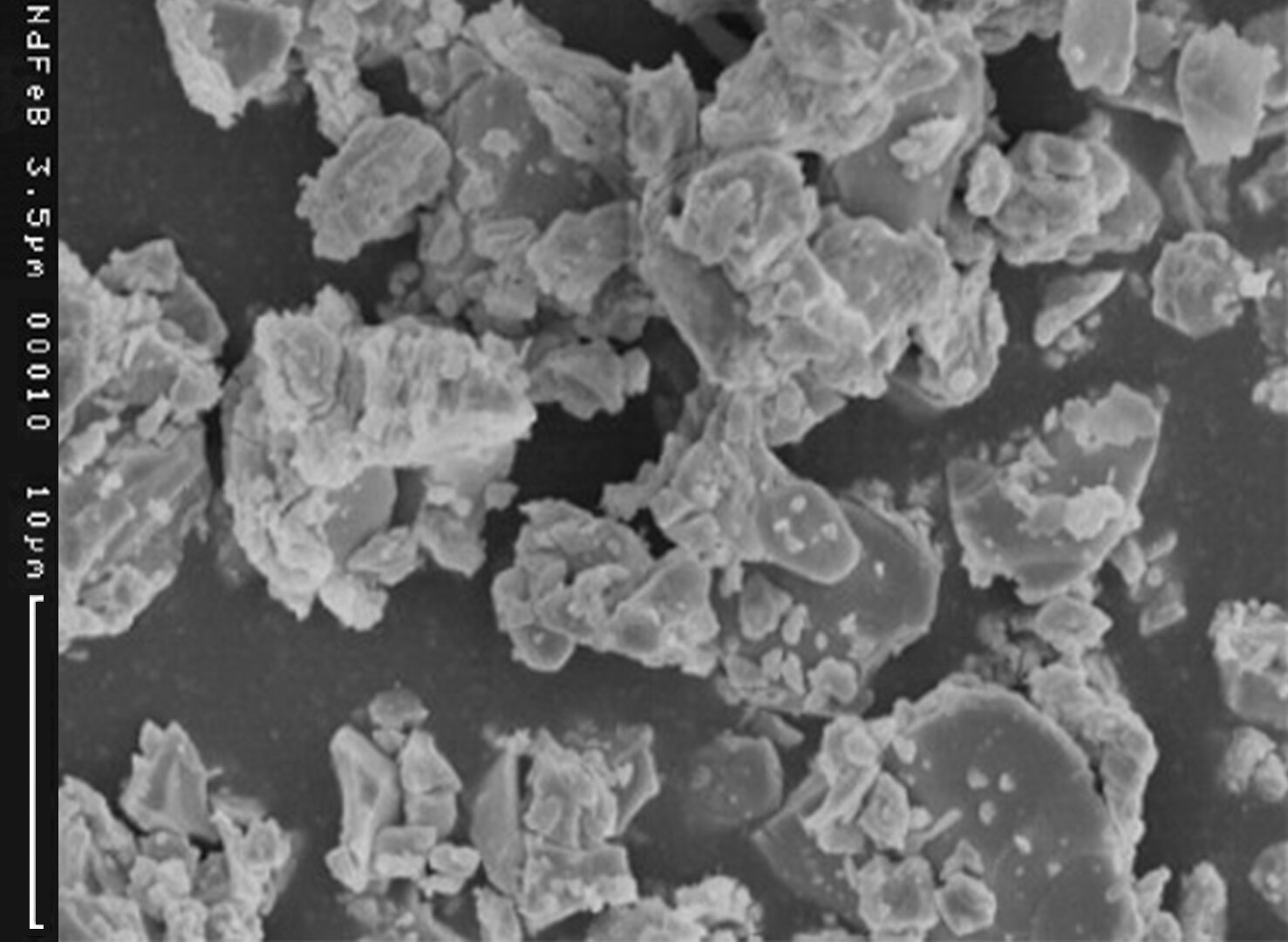
This micrograph shows NdFeB particles forming strong agglomerates due to their strong magnetic adhesion forces.
Download application note for detailed information
Are you interested in additional content? Please register an account. After confirming the registration link brochures, application notes and other documents on particle measurement will be available for download.
Application strengths
- High-resolution particle size measurement of magnetic, cohesive NdFeB powders
- Accurate distribution analysis using dry dispersion with RODOS
- No solvents or dispersants required – no liquid waste handling
- Fast, easy measurements without sample preparation
- Full particle size distribution and mean particle size instead of a single mean value
- Excellent reproducibility and data comparability across batches
Customer benefits
- Stable final magnetic properties with reduced production variability
- Improved product quality through detailed distribution insights
- Early detection of milling deviations enabling timely adjustments
- Enhanced control over pressing and sintering processes
- Simplified laboratory workflows with enhanced testing efficiency and data reliability
Application strengths
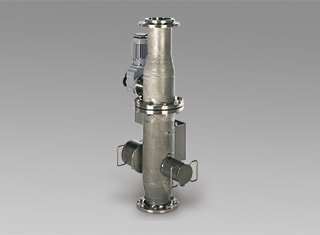
- Supports real-time particle size characterisation for NdFeB production lines
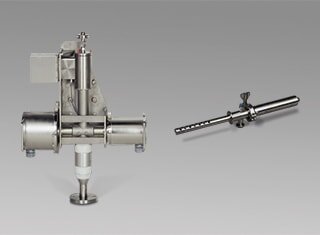
- Patented TWISTER sampler ensures representative sampling
- SCREWSAMPLER 25 allows representative sampling when space is limited
- Built-in RODOS system enables efficient dispersion of magnetic agglomerates
- Fully automated sampling, dispersion and testing, no manual interference
- Compatible with inert gas protection to avoid powder oxidation and combustion risks
- No solvents or dispersants needed, no waste liquid treatment issues
- Fast measurement with data comparable to laboratory systems
Customer benefits
- Enables full-automatic closed-loop production control, enhancing stability
- Eliminates manual sampling errors and safety hazards
- Real-time process feedback for quick parameter adjustment, reducing defective products
- Ensures product consistency and improves quality traceability
- Shortens process adjustment response time, boosting production efficiency