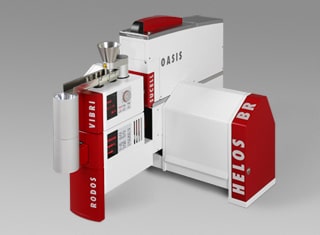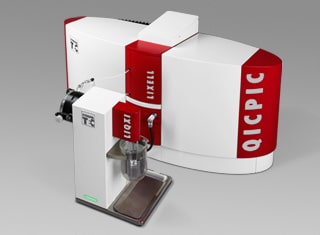







RODOS/L with vibratory feeder VIBRI/L and QICPIC imaging sensor

Particle sizing of fine dry powders with the renowned dry disperser RODOS/L with vibratory feeder VIBRI/L
mounted in the measuring zone of the image analysis sensor QICPIC.

Technical specifications and dimensions.

The RODOS/L is a universal dry dispersing unit applicable for nearly all kinds of dry powders with particle sizes in the range from < 0.1µm to about 4000µm. The patented combination of feeding and dispersing enables a smooth, complete, product adaptable dispersion, which is widely extended into the SUBMICRON range.

Using compressed air to disperse even the finest powder this module generates a dry aerosol which is blown through the light beam and collected in a suction after the analysis. Particle-particle-collision, particle-wall-collision and velocity gradients are applied within the RODOS injector for complete dispersing of the sample. The dispersion energy can be adapted to the demands of the product.

RODOS/L as the fully automated version of RODOS is completely controlled by software. The correct product dependent dispersion force is automatically chosen by the software's database. This makes RODOS/L ideal for validated applications e.g. in the pharmaceutical industry. The sample feeding for RODOS/L can be done by VIBRI/L or the micro-dosing device ASPIROS/L.

If not only dry powder analysis is your daily lab business but also suspensions and emulsions are analysed, RODOS/L can be extended by SUCELL/L into the multifunctional dry and wet dispersion module OASIS.

For the optimum adaptation to the particle size the RODOS/L dispersing line is available with inner diameters of

4 mm
product depending xmax < 1500 µm,
6 mm
product depending xmax < 3000 µm,
10 mm
product depending xmax < 4000 µm,

RODOS/L can be used with all members of the QICPIC or HELOS family. For the operation an extraction unit is required for the sample collection and the generation of a laminar air flow in the measuring zone.

Dosing options

Prerequisite of a good dispersion is a smooth and homogeneous dosing. Two different dosing options are available: The vibratory feeder VIBRI serves most of the applications. For applications requiring micro-dosing please refer to the ASPIROS.

RODOS/L
Dry dispersion for image analysis ( 5 µm - 4000 µm)
and laser diffraction ( < 0.1 µm - 3500 µm)

Add this page to my favorites Send this page to my colleague Print this page
<

RODOS/L

QICPIC with dry disperser RODOS/L and vibratory feeder VIBRI/L

RODOS/L with VIBRI/L view from the connector side of VIBRI

Rer view of RODOS/L with VIBRI/L mounted to a QICPIC imaging sensor

RODOS/L with vibratory feeder VIBRI/L, rear view

Dispersing principle

Following the vacuum generated through expansion of compressed gas applied to the injector, the agglomerates of fine dry particles arrive at low speed in the dispersing line and are subject to immediate acceleration. Three effects are available for the dispersion:

1. particle-to-particle collisions,

Dry dispersion: particle-to-particle collisions

2. particle-to-wall collisions and

Dry dispersion: particle-to-wall collisions

3. centrifugal forces due to strong velocity gradients.

Dry dispersion: centrifugal forces

Control Panel

The standard mode operation of RODOS/L is via control with the WINDOX software. The RODOS/L can also be operated manually via the operational panel.

RODOS/L control panel

The panel allows for the control of Start/Stop of the different dosing units, and the extraction unit, the setting of the primary pressure and the vacuum level of the disperser.

Symbol: Sympatec Cactus